


Pelvic Tilt Problems and How They Affect Your Back and Hips
- Conde Center
- 5 days ago
- 6 min read
Your pelvis plays a bigger role in how you move than you may realize. It connects your upper body to your legs and helps your spine, hips, and core work together when you walk, sit, stand, bend, and exercise.
When the pelvis sits too far forward, backward, or unevenly, it can change how the rest of your body moves. Some people notice lower back tightness. Others may feel discomfort around the hips, buttocks, or thighs. In some cases, the change is subtle and may not cause pain at all.
This is why pelvic tilt problems are not always easy to spot on your own.
Understanding how pelvic position can affect your back and hips may help you recognize when it is time to take a closer look at your movement patterns.
What Is a Pelvic Tilt?
Your pelvis is the group of bones between your spine and legs. Ideally, it stays in a position that allows your spine and hips to move comfortably and efficiently. A pelvic tilt occurs when the pelvis rotates or shifts from its usual position.
An anterior pelvic tilt happens when the front of the pelvis rotates forward. This can increase the curve in the lower back and may be associated with tightness in the hip flexors and changes in how the abdominal and glute muscles work.

A posterior pelvic tilt happens when the pelvis rotates backward. This can reduce the natural curve of the lower back and may change how the hips and spine move. There can also be differences from one side to the other. An uneven pelvis may affect how you stand, walk, or distribute your weight between your legs.
Importantly, pelvic position is not always a problem by itself. The body naturally changes position during movement. What matters more is whether a particular movement pattern is contributing to discomfort, limited motion, or difficulty with everyday activities.
How Can Pelvic Tilt Affect Your Lower Back?
Your pelvis and lower back work together whenever you move.
When the position of the pelvis changes, the lower spine may also adjust to accommodate that change. For some people, this can place additional demand on the muscles and joints around the lower back.
You might notice
Tightness across the lower back
Aching after standing for long periods
Discomfort when sitting for extended periods
Difficulty finding a comfortable position
Reduced flexibility when bending or moving
Recurring lower back soreness
This does not mean that pelvic tilt is automatically the cause of back pain. Lower back discomfort can have many possible causes, including muscle strain, joint problems, injuries, and other conditions.
Instead of focusing only on whether your pelvis is tilted, it is more helpful to look at how your spine, pelvis, hips, and legs are working together.
What Does Your Pelvis Have to Do With Your Hips?
Your pelvis forms the foundation for your hip joints. When you walk, climb stairs, squat, or get out of a chair, your hips and pelvis need to coordinate smoothly.
Changes in pelvic position can affect how the hip muscles are used. For example, spending much of your day sitting can leave certain muscles feeling tight while others may not be working as effectively as they could.
You may then notice stiffness around the front of your hips, discomfort in the buttocks, or a feeling that one side of your body is working harder than the other. Sometimes people try to solve this by stretching one area over and over. But if the underlying movement pattern has not been addressed, the relief may only last temporarily.
Sitting All Day May Play a Role
Modern life gives your hips and pelvis very little opportunity to move. If you work at a desk, drive for long periods, or spend much of your free time sitting, your hips remain bent for hours each day. You may also find yourself leaning forward toward a computer or phone.
Over time, this can contribute to stiffness and changes in the way your body moves. You do not have to stop sitting altogether. Simple changes can make a difference.
Get up regularly during the day. Walk around. Change positions. Give your hips and spine opportunities to move instead of keeping them in one position for hours.
Your Core and Glutes Matter Too
Your abdominal muscles, back muscles, glutes, and hip muscles all help support your pelvis. If some of these muscles are weak or not working well together, other areas may have to compensate.
This is one reason strengthening exercises are often included in programs designed to improve movement and support the lower back.
Exercises such as bridges, controlled squats, and core exercises may be helpful for some people. However, the best exercises depend on your current strength, mobility, symptoms, and overall health.
If an exercise causes pain, especially sharp or worsening pain, stop and have the problem evaluated.
Can Pelvic Tilt Cause Hip Pain?
It can be associated with changes in how the hips move, but pelvic tilt is only one possible factor. Hip pain may come from muscle irritation, overuse, injury, joint problems, or other causes. Pain around the hip can also sometimes be related to the lower back.
That is why trying to diagnose yourself based on posture alone can be misleading.
Instead of asking only whether your pelvis is tilted, it can be more useful to ask whether your current movement patterns are limiting your ability to move comfortably.
How Can You Tell If Your Pelvis Is Out of Position?
It is tempting to stand in front of a mirror and try to judge your pelvic position yourself. You may notice that your lower back looks more curved, your hips appear uneven, or your stomach seems to sit farther forward. But these observations do not tell you exactly what is happening underneath.
Posture also changes naturally throughout the day and during different activities.
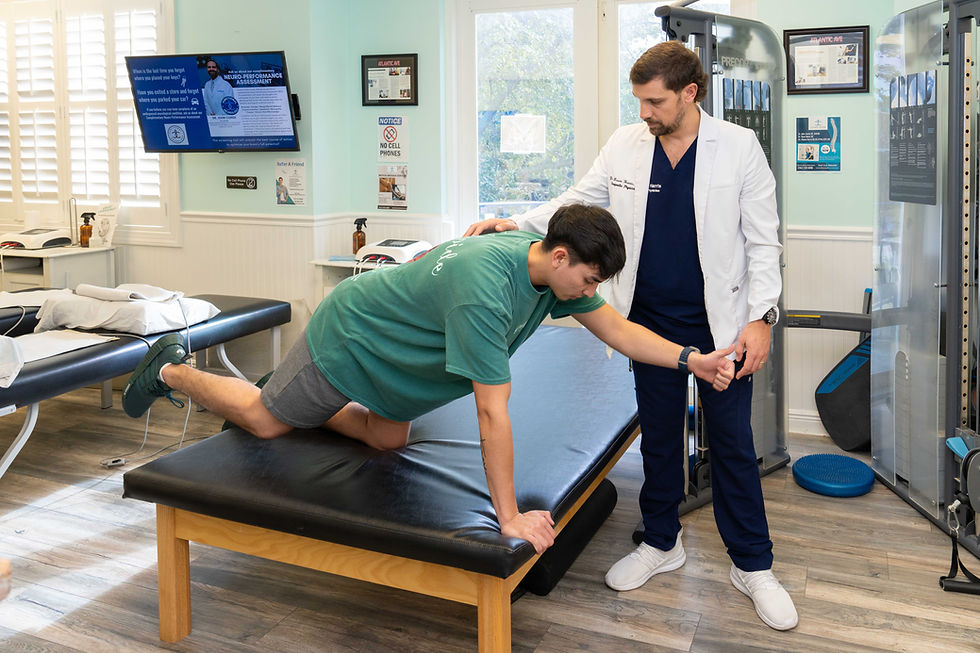
A professional evaluation can provide a better picture by looking at how you stand, walk, bend, squat, and move your hips and spine.
What Can Help?
There is no single solution for every pelvic tilt problem.
For some people, improving daily movement and strengthening certain muscle groups may be enough. Others may benefit from hands-on care or a more detailed evaluation of the spine and hips.
At Conde Center, care focuses on the relationship between the spine, movement, and overall function. Chiropractic care and other treatment options may be considered based on the individual's needs and findings.
The goal is not simply to force the pelvis into a particular position. Your body needs to move through many different positions during normal activities. A better approach is to understand what may be limiting comfortable movement and address the factors that can be improved.
Small Changes Can Help Your Back and Hips
You do not need to completely change your routine to give your hips and lower back more support.
Try standing up and walking around regularly if you sit for much of the day. Pay attention to your sitting position without trying to hold yourself rigidly upright. Include regular movement and strength work in your routine when appropriate.
You can also pay attention to patterns that keep showing up.
Does your lower back become tight after sitting? Does one hip feel stiffer than the other? Do you feel uncomfortable after standing for a long time? Does your back hurt during certain exercises?
These details can help you and your healthcare provider understand what may be contributing to your symptoms.
When Should You Get Help?
Occasional stiffness after a long day is not necessarily a reason for concern. But if back or hip discomfort keeps coming back, limits your movement, or interferes with work, sleep, exercise, or everyday activities, it is worth having it evaluated.
You should seek prompt medical attention after a serious injury or if back pain occurs with symptoms such as significant weakness, loss of bladder or bowel control, or numbness around the inner thighs or groin.
For ongoing discomfort without these warning signs, a qualified healthcare professional can help determine whether the issue may involve your muscles, joints, spine, hips, or another part of your movement system.
Look Beyond the Pelvis
Pelvic tilt can be an important part of the bigger picture, but it is rarely useful to look at the pelvis in isolation.
Your spine, hips, legs, and core all work together. When one part changes how it moves, other areas may have to adjust.
If you have ongoing back or hip discomfort, the goal should be to understand the whole movement pattern rather than simply trying to correct your posture based on what you see in a mirror.
If you are dealing with persistent back or hip discomfort in Delray Beach, Conde Center offers chiropractic care and other treatment options that can be tailored to individual needs.



Comments